



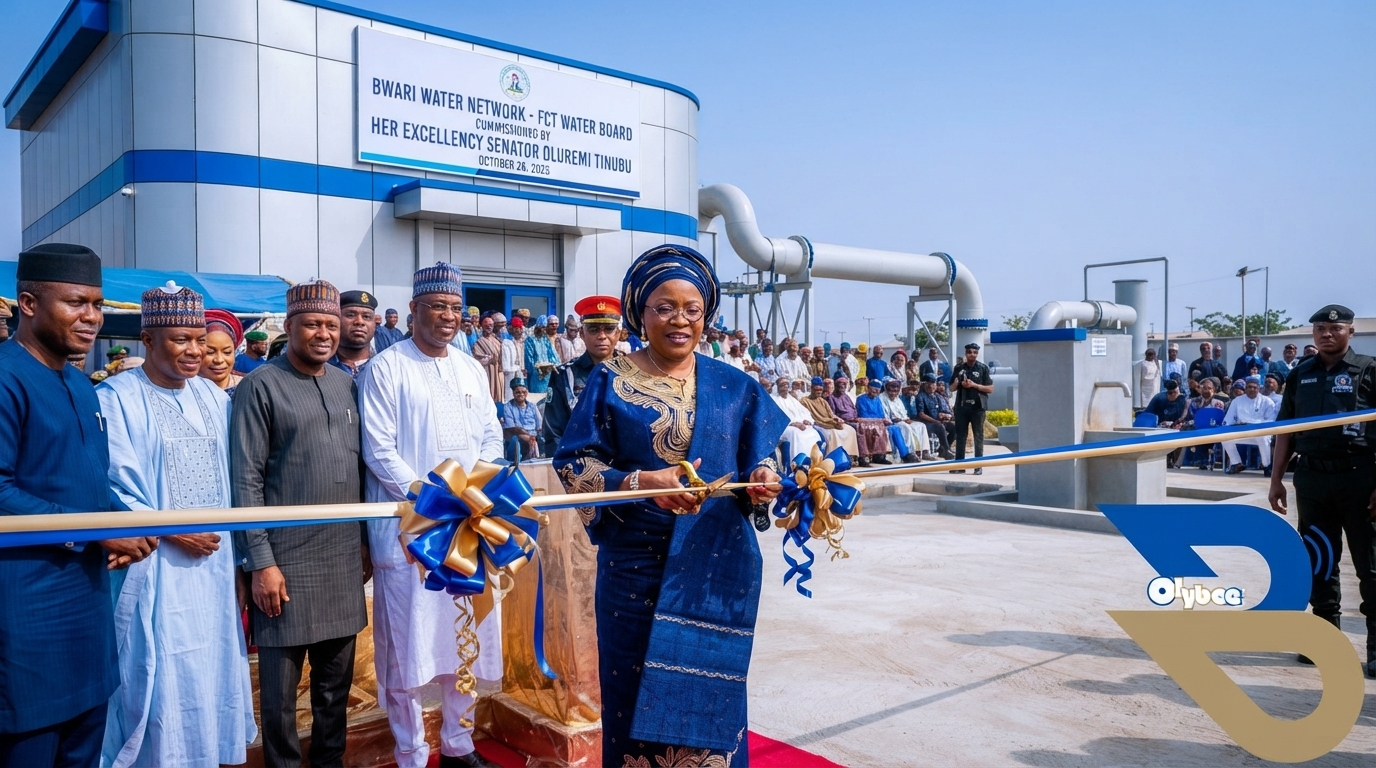
Nigeria’s First Lady, Oluremi Tinubu, has officially commissioned the Bwari water network, a major water supply project serving the Federal Capital Territory. She described the commissioning as proof that the administration’s development promises extend well beyond Abuja’s city centre.
Tinubu spoke at the commissioning ceremony held in Bwari Area Council. There, she tied the project directly to the government’s Renewed Hope Agenda, framing it as tangible evidence of the policy’s impact on ordinary communities.
Why the Bwari Water Network Matters
“The Renewed Hope Agenda of our administration is not a mere slogan,” Tinubu said. “It is a deliberate social contract and a commitment to governance that works for the people.”
For years, residents across Bwari, Ushafa, and neighbouring communities relied on untreated boreholes and streams for their daily water needs. Tinubu called that situation unacceptable and stressed that clean water access should never be treated as optional.
“Water is life. Clean water is dignity,” she said. “It is a fundamental right, not a luxury.”
Consequently, the newly commissioned network aims to change that reality for thousands of residents. The project connects Bwari township and surrounding areas to treated water sourced from the Lower Usuma Dam, reducing dependence on individual boreholes across the district.
Infrastructure Details Behind the Bwari Water Network
The pipeline network stretches 198 kilometres, linking multiple communities to a single, treated water source. This scale suggests a serious infrastructure investment, rather than a small localized fix.
Beyond improving water access, the project has also generated economic benefits. According to Tinubu, the initiative created around 1,600 direct and indirect jobs. As a result, many young people in the area gained fresh employment opportunities tied directly to the project’s construction and rollout.
“This project is more than just laying pipelines, turning on taps,” Tinubu added. “We do not make excuses. We deliver results.”
Her comments suggest the administration wants this project viewed as a broader governance statement, not merely a utility upgrade. Given the scale of the pipeline network and the jobs it created, that framing carries some weight.
What Comes Next for FCT Water Access
Looking ahead, Tinubu assured residents that similar water projects would soon reach other satellite communities within the territory. She specifically named Kuje, Kwali, Gwagwalada, and Abaji as areas expected to benefit before the administration’s tenure ends.
This suggests the Bwari commissioning is not an isolated event, but rather one phase of a wider rollout across the FCT. If the administration follows through, several additional communities currently relying on boreholes could see similar upgrades in the coming months.
Notably, this water expansion effort follows a broader pattern of infrastructure announcements from the FCT administration this year. Officials have repeatedly emphasized that no district within the territory should feel left behind in development planning.
Broader Context on Nigeria’s Water Access Challenge
Nigeria continues to face significant challenges around access to safe drinking water, particularly in peri-urban and rural areas surrounding major cities like Abuja. Many communities still depend on boreholes or untreated surface water, which can carry serious health risks over time.

Projects like the Bwari water network therefore represent more than routine infrastructure spending. They address a persistent public health concern that has affected FCT satellite communities for years. Reducing reliance on untreated sources could meaningfully improve health outcomes for the populations served.
For more background on the water source feeding this project, readers can consult the FCT Administration’s page on the Lower Usuma Dam. General context on Nigeria’s water infrastructure challenges is also available via Wikipedia’s overview of water supply and sanitation in Nigeria.
A Test of Follow-Through
Ultimately, the success of the Bwari water network will depend on consistent maintenance and expansion beyond the commissioning ceremony itself. Communities that have waited years for reliable water access will likely judge the project by long-term service delivery, not just the ribbon-cutting moment.
For now, though, the commissioning marks a concrete milestone for a district that has struggled with water access for years. If the promised extensions to Kuje, Kwali, Gwagwalada, and Abaji materialize as described, the project could become a template for similar interventions across other underserved parts of the country.



Leave a Reply
You must be logged in to post a comment.