




Introduction
The Ekiti governorship election 2026 has delivered a resounding verdict. Governor Biodun Oyebanji of the All Progressives Congress (APC) romped to a second term with a massive 319,224 votes. The Independent National Electoral Commission (INEC) confirmed his victory in the early hours of Sunday, June 21, following Saturday’s poll. His closest rival, Peoples Democratic Party (PDP) candidate Olumayokun Oluyede, pulled just 40,533 votes. Furthermore, African Democratic Congress (ADC) candidate Dare Bejide finished a distant third with only 12,872 votes. That winning margin — nearly 279,000 votes — leaves absolutely no room for ambiguity.
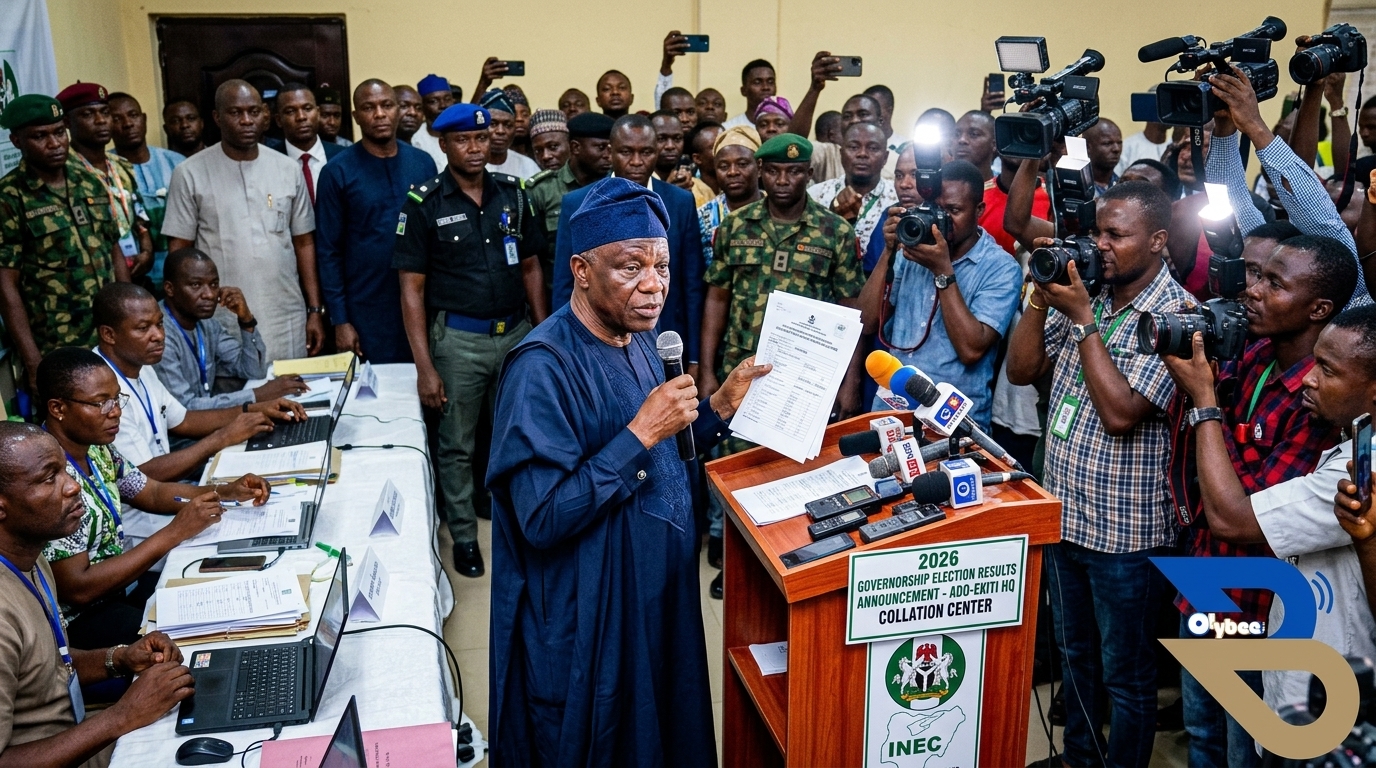
INEC’s Returning Officer, Prof. Adenike Oladiji, read out the official declaration at the commission’s headquarters on Iyin Road in Ado-Ekiti. She also serves as Vice Chancellor of the Federal University of Technology, Akure. The announcement came before dawn on Sunday. “Therefore, I, Adenike, am the returning officer for the 2026 Ekiti governorship election,” she told party agents and journalists gathered at the venue. She then concluded, “Oyebanji Abiodun Abayomi, having satisfied the requirements of the law, is hereby declared the winner and stands re-elected.”
Ekiti Governorship Election 2026: What the Voter Numbers Reveal
A close look at the voter data tells a gripping story. Ekiti State has 988,251 registered voters. However, only 384,940 of them received accreditation on election day, Saturday, June 20. Out of the 382,109 votes cast, the total valid votes reached 375,777. Oyebanji’s 319,224 valid votes account for the lion’s share of that figure. Remarkably, both his opponents combined barely crossed 53,000 votes. That kind of margin is not just a win — it is a political statement.
Moreover, the APC swept through all 16 local government areas without dropping a single one. In Ado LGA, the state capital, Oyebanji secured 38,026 votes while the PDP pulled just 3,817. In Ekiti West, the APC scored 28,258 against the PDP’s 3,644. Similarly, in Irepodun/Ifelodun LGA, Oyebanji’s tally hit 29,278 compared to the PDP’s 2,119. Even in smaller LGAs, the pattern held firm. Ilejemeje LGA delivered 8,984 votes for the APC, against just 1,243 for the PDP. The consistency of these margins across all 16 LGAs is truly striking.
Additionally, some LGAs saw the opposition struggle badly below four figures. In Emure LGA, the PDP polled just 851 votes. In Ikole LGA, the figure fell even lower to just 750 — the weakest single-LGA tally for any party across the entire election. Meanwhile, the ADC’s best outing came in Ijero LGA with 2,026 votes. Nevertheless, that was nowhere near enough to threaten APC’s grip on the state.
PDP Candidate Loses the Ekiti Governorship Election 2026 Even on Home Turf
Perhaps the most dramatic subplot of this election belongs to PDP candidate Olumayokun Oluyede. He hails from Ikere Ekiti, so most observers expected him to dominate in his Ikere Local Government. That expectation did not materialise. In Ikere LGA, the APC scored 11,116 votes while the PDP came second with 9,872. Although the race was tighter there than anywhere else, Oluyede still lost at home. Losing in your own backyard carries a particularly painful political sting. For the opposition, it reinforced just how difficult this political terrain truly is.
Additionally, Dare Bejide’s ADC never made any meaningful inroads across the state. Their strongest showing came in Ekiti East LGA with 1,730 votes. Beyond that, most LGA totals for the ADC sat below 1,000. Consequently, this race was effectively a one-sided contest from first count to last.
Full Results Breakdown: How Every Local Government Voted
Here is the complete tally from all 16 local government areas, as collated at the INEC State Collation Centre:
| Local Government Area | APC | PDP | ADC |
|---|---|---|---|
| Efon | 8,742 | 2,051 | 201 |
| Ijero | 25,506 | 2,479 | 2,026 |
| Ikere | 11,116 | 9,872 | 245 |
| Emure | 14,325 | 851 | 732 |
| Ekiti South West | 14,705 | 1,800 | 1,076 |
| Ido/Osi | 17,901 | 1,449 | 561 |
| Ekiti West | 28,258 | 3,644 | 674 |
| Ado | 38,026 | 3,817 | 1,054 |
| Ilejemeje | 8,984 | 1,243 | 579 |
| Ise/Orun | 12,907 | 1,627 | 365 |
| Oye | 18,975 | 2,891 | 998 |
| Moba | 20,500 | 1,572 | 994 |
| Ayekire/Gbonyin | 17,133 | 1,563 | 314 |
| Ikole | 26,508 | 750 | 812 |
| Irepodun/Ifelodun | 29,278 | 2,119 | 511 |
| Ekiti East | 26,359 | 2,795 | 1,730 |
The APC topped the chart in every single local government. Therefore, not one opposition party won any LGA across the entire state.

What Oyebanji’s Victory Means for Ekiti Going Forward
Governor Oyebanji now enters his second and constitutionally final term. Under Nigeria’s law, state governors may serve a maximum of two four-year terms. Therefore, this mandate is both a personal milestone and Ekiti voters’ final say on his leadership. Celebrations erupted across the state on Sunday morning following the official declaration. Many residents view the outcome as a strong endorsement of Oyebanji’s first-term governance track record.
For a broader understanding of how Nigeria’s electoral system operates, visit the official INEC website, where you can access electoral guidelines, voter registration data, and official results. Additionally, for historical context on governorship races across Nigeria, the Wikipedia overview of Nigerian gubernatorial elections offers useful background on how these contests have shaped the country’s political landscape over the decades.
With his mandate now sealed and the numbers firmly in his corner, Ekiti State turns its attention toward Oyebanji’s inauguration. His second term carries high expectations from the voters who backed him so overwhelmingly. The governor takes office again with a commanding majority — and the heavy responsibility that comes with it.





Leave a Reply
You must be logged in to post a comment.