


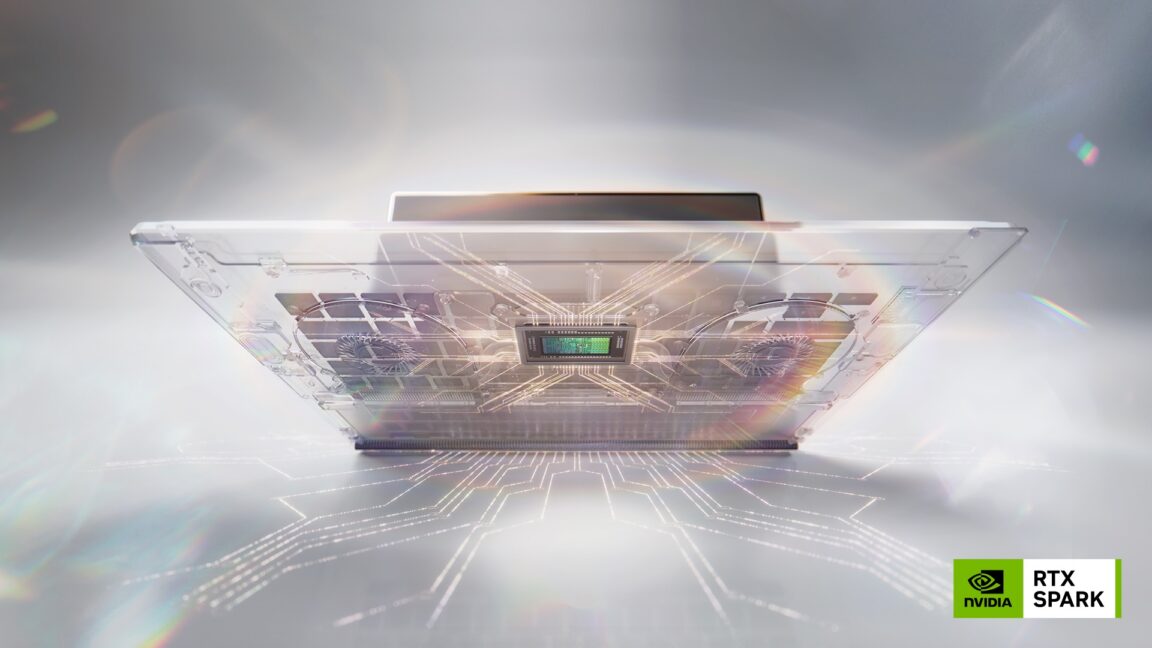
TAIPEI, Taiwan — Forty years of clicking and typing may be coming to an end. At NVIDIA GTC Taipei on June 1, NVIDIA CEO Jensen Huang took the stage to unveil the RTX Spark, a new superchip the company says fundamentally resets what a personal computer is — and what it can do. The announcement, made in partnership with Microsoft, marks the arrival of the world’s first Windows PCs engineered from the ground up for personal AI agents.
“The PC is being reinvented,” said Huang. “For forty years, you launched apps. Click. Type. With RTX Spark and Microsoft Windows, you ask — and the PC does the work. RTX Spark brings everything NVIDIA has built — CUDA, RTX, our AI platform — into a single superchip. Local agents. Frontier models. Creative workflows. RTX games. All on a laptop. This is the new PC. The personal AI computer.” iTWire
What RTX Spark Actually Is
The RTX Spark superchip features an NVIDIA Blackwell RTX GPU with 6,144 CUDA cores and fifth-generation Tensor Cores with FP4 precision, connected via the NVIDIA NVLink-C2C chip-to-chip interconnect to a high-performance, 20-core NVIDIA Grace CPU. MediaTek, a market leader in Arm-based system-on-a-chip designs, collaborated with NVIDIA on the custom CPU design, contributing to its best-in-class power efficiency, performance and connectivity.
The headline performance figures are striking. RTX Spark delivers 1 petaflop of AI compute alongside up to 128GB of unified memory — numbers that, until recently, required a dedicated workstation rather than a slim laptop. The chip consolidates three decades of NVIDIA platform development — CUDA, RTX, DLSS, FP4, TensorRT, OptiX, Reflex, and G-SYNC — into a single package designed for battery-powered, portable hardware.
The Agent Problem — and How They’re Solving It
AI agents have been gaining traction rapidly among developers, but mainstream adoption on personal PCs has stalled for a specific reason. Broad adoption has been limited by the inability to run agents securely and privately on users’ primary PCs. NVIDIA and Microsoft are partnering to address this challenge by delivering a robust, secure Windows platform for on-device agents.
The security architecture they’ve built is layered. The collaboration begins with new Windows security primitives and the NVIDIA OpenShell runtime. The new Windows primitives deliver identity, containment, policy and end-to-end security capabilities to build and run agents natively. NVIDIA OpenShell provides additional policy capabilities for the user to define what agents can and cannot do, the ability to intelligently route queries to local models based on the user’s privacy policies, and the ability to disguise personal information in queries sent to cloud models.
Leading agent platforms are already building on this foundation. Vincent Koc, chief architect at the OpenClaw Foundation, described the combination as enabling users to leverage “a fully integrated stack for private, personal agents running on device.” Dillon Rolnick, CEO of Nous Research, added that RTX Spark and NVIDIA OpenShell give Hermes users “a powerful and secure environment for agents to run and work alongside you — you realize you’re buying a full-fledged assistant, not a typical laptop.”
From this foundation, NVIDIA and Microsoft’s collaboration will expand to new RTX Spark-powered Windows agent experiences accessible directly from the Windows taskbar.
Microsoft’s own leadership underscored the significance of the moment. “Our goal is to deliver unmetered intelligence to every home and every desk with Windows,” said Satya Nadella, chairman and CEO of Microsoft. “RTX Spark marks a real breakthrough towards that vision.”
What It Can Do: Creators, Developers, and Gamers
Beyond agents, RTX Spark is positioned as a serious creative and gaming platform. Users can render ultralarge 90GB 3D scenes with OptiX and DLSS, edit 12K 4:2:2 video with the NVIDIA Blackwell decoder, run 120-billion-parameter large language models with 1 million tokens of context, and play AAA games at 1440p resolution and over 100 frames per second with ray tracing, DLSS and Reflex.
New RTX capabilities include DLSS 4.5 Ray Reconstruction featuring a second-generation transformer model — coming to Blender 5.3 and dozens of games — and RTX Video with 4x Frame Generation, coming to ComfyUI.
Georgi Gerganov, founder of llama.cpp, described the hardware as transformative for private agents: “RTX Spark laptops change the game by multiplying the amount of context processing and putting it directly into a beautiful, portable chassis. Highly optimized models running locally through llama.cpp with RTX Spark’s AI performance will unleash the next wave of personal, private agents.”
Adobe Rebuilds Photoshop and Premiere From Scratch for RTX Spark
One of the most significant creative announcements buried inside the launch is Adobe’s decision to fundamentally rearchitect two of its flagship products. NVIDIA is partnering with Adobe to rearchitect Adobe Premiere and Photoshop for RTX Spark, delivering up to 2x faster AI, editing, coloring and effects across creative workflows.
Adobe Premiere will feature a new video pipeline that taps into RTX Spark’s unified memory, Blackwell GPU and TensorRT software, delivering real-time performance for editing and color correction, GPU-accelerated AI performance and more efficient rendering of complex timelines.
Adobe’s next-generation Photoshop engine will be optimized for GPU-accelerated compositing, enabling live filters, high dynamic range and modern natural brushing. The AI-native pipeline is built to harness the full power of RTX Spark, including TensorRT.
Shantanu Narayen, chair and CEO of Adobe, called it “the expansion of our partnership with NVIDIA and Microsoft” that will make creative experiences “faster and more powerful than ever,” adding that together they are “building AI-native creative experiences for RTX Spark that deliver the performance, intelligence and responsiveness people need to create at the pace of their ambition.”
Hardware Partners and Availability
RTX Spark-powered slim Windows laptops with all-day battery life and premium displays, as well as compact desktop PCs, will be available this fall from ASUS, Dell, HP, Lenovo, Microsoft Surface and MSI, with models from Acer and GIGABYTE to follow. Engineered to be as slim as 14 millimeters and as light as three pounds, RTX Spark laptops will be available in 14-inch configurations.
Over 100 Windows software providers including Blackmagic Design, Blender, CapCut, ComfyUI and OTOY, and game developers including KRAFTON, NetEase, Remedy Entertainment, Riot Games and XBOX are embracing the new RTX Spark platform. RTX technology is already active across more than 1,000 games and applications, giving the ecosystem an immediate foundation to build on.
The announcement — coming out of a three-year collaboration between NVIDIA and Microsoft — positions RTX Spark directly against competing approaches from AMD, Intel, and Apple. Whether the promise of on-device, private AI agents running at petaflop scale resonates with everyday users will ultimately determine whether this is the beginning of a genuine PC paradigm shift — or an ambitious bet that takes longer than one product cycle to pay off.


Leave a Reply
You must be logged in to post a comment.