



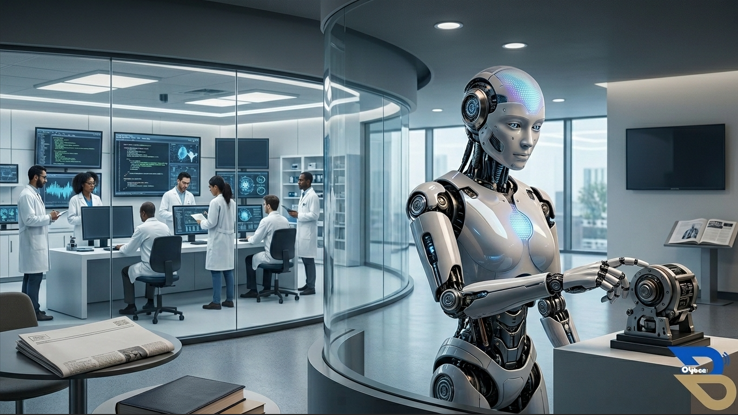
Humanoid robots do not have independent will. What resembles “a mind of their own” is a product of complex autonomy stacks of perception, prediction, planning, and control, plus learning systems that sometimes behave in ways difficult to anticipate outside their training data. That gap between what people expect and what the robot actually optimizes for is exactly why many believe wide deployment isn’t ready yet: reliability, safety, accountability, and trust still lag behind in demos.
Why actions can look like “free will”
Humanoids are increasingly running autonomy stacks that create this illusion of intent:
-
Perception → World model
Cameras, LiDAR, depth sensors, IMUs, and tactile arrays form a continuously updating map of the environment. The robot labels objects, estimates human pose, and tracks motion. -
Prediction → What might happen next
Models predict where people, pets, and other objects will be seconds into the future. That’s how the robot can plan around futures, not just the present. -
Planning → Goal to body motions
While task planners decide “what to do” (open door, hand over object), motion planners and whole-body controllers decide “how to do it” – by determining foot placement, arm trajectories, and joint torques, all within milliseconds. -
Learning-based policies → Adaptation
Reinforcement learning, imitation learning, or large-model policies fill in the “last mile” for when rules are brittle, like when grasping a crumpled bag. These policies interpolate-and sometimes extrapolate-beyond what engineers explicitly wrote.
When these modules run fast and continuously, the robot seems to “decide” things on its own: it pauses, re-routes, or shifts its stance in ways that feel intentional. It’s not volition; it’s optimization over noisy inputs and changing constraints. Still, that sometimes produces actions that humans don’t anticipate-fueling the “mind of its own” narrative.
The technical reasons experts remain cautious
1) Distribution shift and edge cases
Robots do well in demo settings and structured labs. Performance degrades significantly in real, messy homes and warehouses. Wet floors, shiny surfaces, kids zipping by, or cables everywhere could break perception and planning. Even a little glitch in sensors could cascade into odd behaviors: hesitations, oscillations, or incorrect grasps.
2) Value alignment at the embodied level
Unlike chatbots, embodied misalignment is physical: a planner optimizing for task completion and joint safety might still bump a mug, or a person, if the cost model underweights social comfort, property damage, or subtle human cues. Encoding “common sense” social norms into real-time controllers is still immature.
3) Verification and interpretability
We can unit-test code; we cannot fully “unit-test” a learned policy across the near-infinite state space of the real world. Formal verification for continuous, high-DOF humanoids is an active research area, but today most safety assurance relies on heuristics, simulation, and limited scenario testing.
4) Actuation limits and contact uncertainty
Human environments are built for human hands and compliance. Humanoids need to be able to manipulate doors, textiles, drawers, and fragile objects while balancing. Small contact misestimates may topple the robot or crush an object. Compliance added by series elastic actuators and torque control helps but complicates control.
5) Power, heat, and runtime
High-compute perception and planning quickly drain batteries. Longer shifts require hot-swap batteries, tethered power, or reduced capability, each with safety trade-offs. Heat management to keep actuators and electronics within spec is a practical bottleneck.
6) Human-robot interaction (HRI) under uncertainty
People infer intent from micro-motions, which are gaze, torso yaw, and hand pre-shape. Humanoids often lack legible signaling. If a robot steps toward you while replanning, it can feel aggressive or eerie-even if safe. That perception gap damages trust.
7) Compliance, liability, and standards
Industrial and collaborative robot standards exist, but humanoids operating in public or domestic spaces sit in a grey zone. Who is responsible for harm when part of the stack is learned, updated over-the-air, and context-dependent? Until certification pathways mature, cautious deployment is rational.
Why the public feels they’re “not ready” (and they have a point)
-
Unpredictable micro-failures feel like agency.
A two-second freeze while the planner replans reads as “thinking.” A sudden step to regain balance looks like “changing its mind.” -
Demo-to-reality gap.
Viral clips compress dozens of attempts into one success. Viewers intuit the selection bias and assume fragility. -
Friction with social norms.
Humans negotiate space through eye contact and subtle cueing; the humanoids rarely communicate intent clearly, so people stay tense. -
Media framing.
“Mind of their own” headlines amplify the unease that already accompanies near-human form factors-the uncanny valley isn’t just looks, it’s behavior.
What would make humanoids “ready” for 21st-century use
-
Capability gating and layered autonomy
-
Default to conservative modes; escalate capability only in well-characterized contexts.
-
Integrate human-in-the-loop by providing seamless “resume control” paths and explicit handover signals.
-
-
Red-teaming and adversarial testing
-
Standardize public test suites: stairs with clutter, slippery tiles, low-light, pets, children, occluded handles.
-
Require pass/fail dashboards and post-deployment incident reporting.
-
-
Behavioral guardrails at the control layer
-
Hard constraints for speed, force, and proximity around humans; reflexive safe-stop and posture recovery.
-
Intent-aware planners that take humans’ comfort zones (proxemics) into consideration alongside task success.
-
-
Legibility and social signaling
-
Built-in “body language”: gaze indicators, LED intent arrows, audible prompts before motion (“I’m reaching to your left”).
-
Predictable timing of motion so humans can anticipate trajectories.
-
-
Data governance and auditability
-
Tamper-evident logs for each contact event and policy decision path.
-
Clear update cadences with rollbacks and signed model versions for forensic accountability.
-
-
Certification pathways
-
Industry-specific certifications include household assistance, retail floor, eldercare common areas, and back-of-house logistics, all with different thresholds and insurance structures.
-
-
Hardware built for failure
-
Compliant grippers, rounded edges, soft skins with tactile arrays, low-inertia limbs, and energy, limiting transmissions reduce the risk when plans go wrong.
-
[inline_posts box_title=”Recommend Posts” align=”alignleft” textcolor=”#000000″ background=”#f2f2f2″]48, 51, 60[/inline_posts]
credit:WhistlinDiesel
How to watch a “mind of their own” clip like an expert
Next time you see a humanoid video with that caption, look for:
-
Replanning tells: brief pauses, reorientation steps, and head/gaze shifts before the action.
-
Safety reactions: Hands open when near humans, slowed approach near obstacles, and recovery steps after contact.
-
Scene constraints: lighting, floor texture, object variety, curated or not?
-
Cuts and resets: signs of selection bias vs. continuous, unedited runs.
-
Human interaction: did the robot communicate intent before moving into someone’s personal space?
These cues distinguish true robustness from “demo polish.”
Bottom line
Humanoid robots aren’t developing consciousness, but their autonomy can even surprise their makers. Until the day when reliability across messy edge cases, legible social behavior, robust safety guardrails, and clear certification all exist side by side, skepticism of broad deployment is very reasonable. The way forward isn’t hype; it’s methodical engineering and transparent testing, with designs that anticipate failure-and fail safely.



Leave a Reply
You must be logged in to post a comment.