




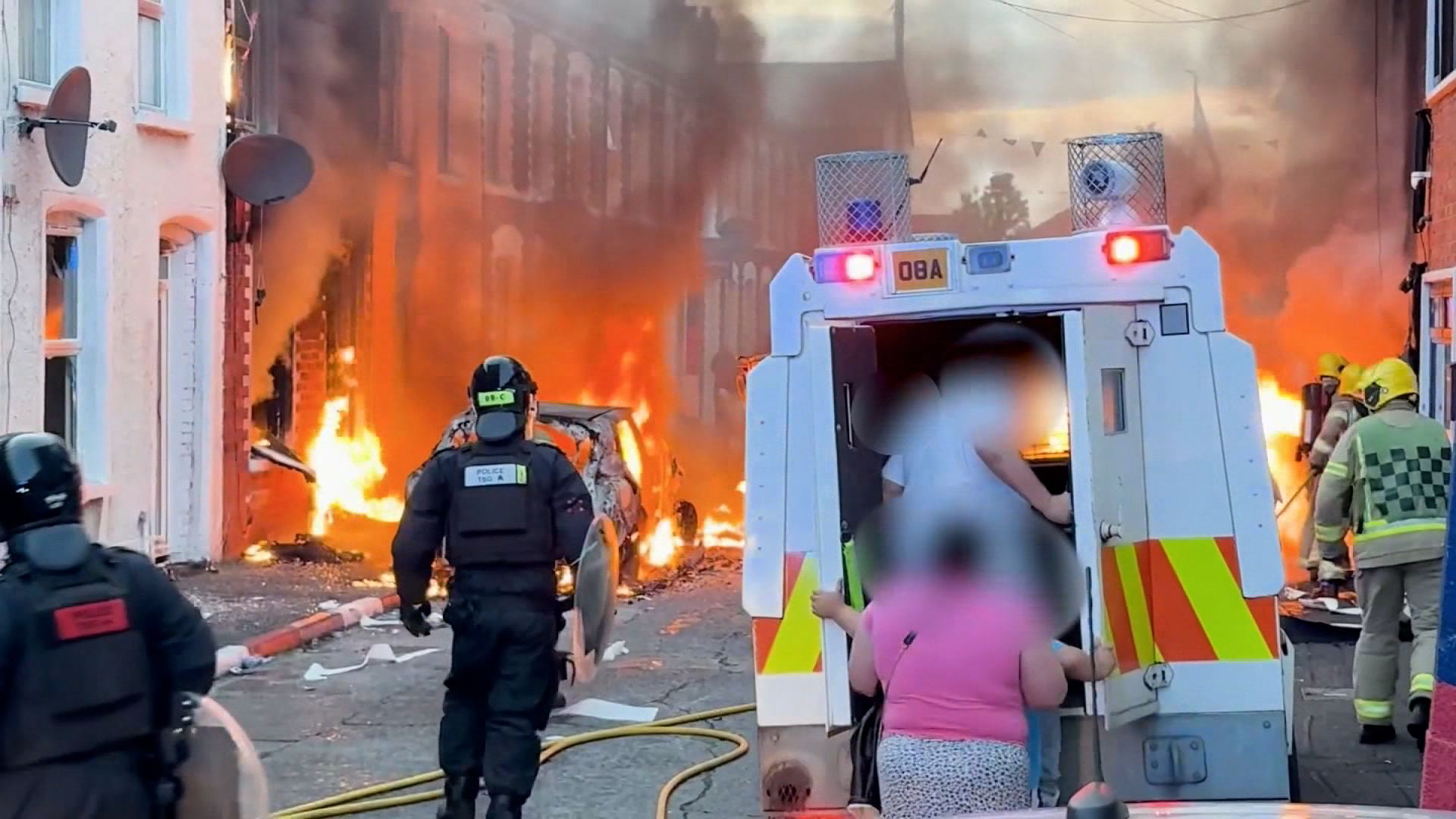
Violent anti-migrant riots have gripped Belfast for a second consecutive night, with healthcare workers including nurses harassed, stopped and intimidated on their way to hospital shifts, homes set ablaze across multiple suburbs, and a two-month-old baby rescued by police as fire spread through a neighbourhood. The unrest, which erupted after a brutal knife attack and spread rapidly through online video, has drawn condemnation from the UK Prime Minister, Northern Ireland’s chief constable, and the victim’s own family.
It is being described by some politicians as the worst racially motivated disorder Northern Ireland has seen in years.
The Stabbing That Sparked the Violence
Stephen Ogilvie, a 44-year-old disabled man, was attacked by another man with a kitchen knife on Kinnaird Avenue in north Belfast on the night of June 8, 2026, at around 10:30 pm. Several bystanders confronted the suspect until police arrived one man, Maitiu Mág Tighearnán, fought the attacker off with a hurley.
Victim Stephen Ogilvie lost his left eye in the attack and suffered wounds to his other eye, back and face, a detective told the court the following day. Police charged Hadi Alodid, a 30-year-old Sudanese national, with attempted murder. He was also charged with threatening to kill an NHS radiographer allegedly telling medical staff “I will kill you” while being treated for a hand injury and with possession of a knife. He was refused bail and the case adjourned to July 8.
Alodid entered the United Kingdom in 2023, was granted refugee status that same year, and had been given leave to remain until 2028. Authorities said there is no evidence linking the attack to terrorism.
Video of the attack circulated online throughout the following day, sparking widespread calls for violent protest alongside tributes to those who intervened. Northern Ireland Secretary Hilary Benn praised the people who stepped in as showing “the very best of humanity.”
Two Nights of Disorder – What Happened Across Belfast
The rioting that followed over two consecutive nights was widespread and co-ordinated in its targets.
On the first night, masked men claiming to be “getting the foreigners out” were seen kicking in doors and windows on the Lower Newtownards Road. At least three houses, a Middle Eastern supermarket, a Glider bus, and numerous vehicles were set ablaze across Belfast. A police car was set on fire in Portadown. Traffic was disrupted by rioters in Derry. In Newtownabbey, multiple cars were set alight, and a Turkish barber shop was attacked in Ballyclare. Many local businesses in Belfast closed early, as did Translink services. The fire brigade attended 62 incidents across the city.
Twenty-seven people were made homeless after rioters went door-to-door trying to find immigrants. A two-month-old baby had to be rescued during the attacks, according to the PSNI’s chief constable.
On the second night, police fired water cannons on rioters in Newtownabbey who were hurling petrol bombs at officers. Sixteen people were arrested and two charged following that night’s disorder alone. Twelve officers were injured.
The Accountability Project Northern Ireland, a group of volunteers that monitors online anti-immigration activity, stated it had warned the PSNI repeatedly since October 2025 that anti-immigration activists were circulating the home addresses of properties that were eventually targeted during the riots.
Nurses and Healthcare Workers Targeted
The attacks on Belfast’s migrant community included the intimidation of the very workers staffing the hospitals caring for the riot’s victims.
Assistant Chief Constable Henderson of the PSNI directly addressed what he called “the disgraceful threats and intimidation directed to our nurses, carers and other healthcare workers,” condemning the targeting of people on their way to and from work.
UNISON Northern Ireland, the union representing healthcare workers, reported that workers had been followed, stopped by people demanding to see their identification, and intimidated in their own homes. The union stated: “They are care workers, nurses, classroom assistants and a host of other occupations delivering key public services. They are here because our government and public services invited them to fill critical shortages in these vital services.”
The head of the Royal College of Nursing in Northern Ireland, Professor Rita Devlin, said many migrant nurses had been left scared to attend work. “Some of these staff are the very same people who had to deal with the horrific injuries inflicted on an individual and they are now being prevented from going to work to help others. These staff are being traumatised twice,” she said.
The Victim’s Family: “Do Not Do This in Our Name”
In an appeal that cut through the noise of the disorder, Stephen Ogilvie’s own family publicly called for the violence to stop.
The family stated: “We do not want this terrible tragedy to be used to divide people or fuel hostility.” In a second statement they were even more direct: “Do not do this in the name of our loved one as we do not share the same values.”
They added: “We have many migrants who make a deeply valuable contribution to our country.”
UK Prime Minister Keir Starmer condemned the original knife attack as “horrific.” People in multiple areas were left “extremely distressed” after home addresses were shared on social media and messaging apps, the PSNI confirmed, calling the activity “reckless” and “unacceptable.”
Political Reaction and International Attention
The riots quickly attracted international commentary. One politician described the unrest as “a race-based pogrom.” The Northern Ireland Fire and Rescue Service said it responded to 62 incidents between 7 pm and midnight on the first night alone.
Riot scenes showed people standing next to burnt-out cars and homes as anti-immigrant violence spread across eastern Belfast, with fires burning around police vehicles in Glengormley, north of the city.
The riots are the most severe anti-migrant disorder in Northern Ireland since disturbances in 2025, when riots in Ballymena and Belfast followed an alleged sexual assault, and in 2024, when widespread unrest spread across Great Britain and Northern Ireland in the aftermath of the Southport stabbings.
For the latest official updates from Northern Ireland’s police service, the PSNI website is publishing rolling statements as the situation develops.
FBI and Europol Shut Down LeakBase Hacking Forum →
Google User Data Australia: What the Numbers Show →
The streets of Belfast were quieter on Thursday morning, but with further protests threatened and extra officers drafted in from forces across Great Britain, the situation remains fragile. At the centre of it all, a man lost an eye, healthcare workers are afraid to leave their homes, and a family is begging strangers to stop committing violence in the name of someone who has explicitly asked them not to.






Leave a Reply
You must be logged in to post a comment.