




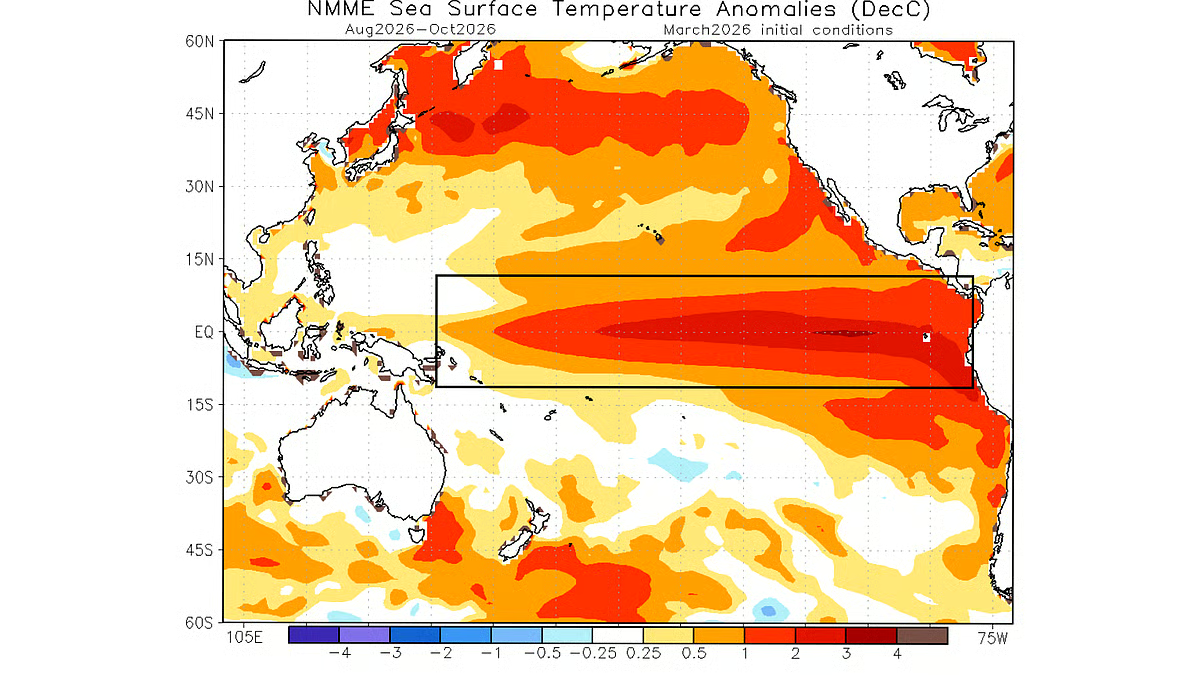
El Niño has officially arrived and the scientists watching it form in the Pacific Ocean are not hiding their alarm. The U.S. National Oceanic and Atmospheric Administration confirmed its existence on Thursday, June 11, along with a forecast that places a 63% chance on the event reaching “very strong” or “Super El Niño” status a threshold that has been crossed only a handful of times since records began in 1950. This El Niño is forming in a world already running more than 1.4°C above pre-industrial temperatures, a combination that climate scientists say takes the planet somewhere it has never been in modern human history.
The nicknames it has already earned “super”, “Godzilla” give some indication of how the scientific community is assessing its potential.
What NOAA’s Announcement Actually Said
NOAA’s Climate Prediction Center is giving this El Niño a 63% chance of becoming a “very strong” event colloquially known as a Super El Niño and one of the largest El Niño events in the historical record dating back to 1950.
NOAA says there is a 100% chance El Niño sticks around through the fall, with odds staying sky-high as it rolls into winter.
NOAA’s June 2026 forecast update confirms that, as of this month, El Niño is already underway, with nearly 90% odds of an event reaching at least “strong” intensity.
Among the models producing forecasts, several are projecting sea surface temperature anomalies in the Niño 3.4 region of the equatorial Pacific climbing beyond 4 degrees Celsius above average by November numbers that push past the upper boundary of the standard forecast chart. A “super” El Niño is defined by surface temperatures exceeding 2 degrees Celsius above baseline. Some ensemble runs are projecting nearly double that threshold.
Meteorologists forecast this El Niño will rival or exceed the record event that began in 1997, which triggered billions of dollars in damage from heat waves, floods, droughts, tornadoes, and wildfires across multiple continents.
What Makes This One Different and Potentially Historic
Every El Niño reshapes global weather patterns. This one arrives with a compounding factor that previous events did not face.
Climate scientist Dr. Daniel Swain at the University of California Agriculture and Natural Resources stated clearly: “We’ve never experienced a strong or very strong El Niño event amid pre-existing conditions that were this warm globally. Therefore, it would not be surprising to see some unprecedented global impacts by later in 2026 into 2027 in terms of flood, drought, and wildfire-related extremes.”
Paul Roundy, a professor of atmospheric science at the University at Albany, went further, saying: “I would suggest there is roughly a 50 per cent chance of the event becoming the strongest in the historical record right now.”
The early indications including warmer water pushing toward the surface of the Pacific have been so strong and consistent that forecasters have all been converging on the same ultra-strong El Niño prediction, which is unusual given that El Niño forecasts at this time of year are normally all over the place.
The World Meteorological Organization was equally direct. WMO Chief of Climate Prediction Wilfran Moufouma Okia said: “After a period of neutral conditions at the start of the year, climate models are now strongly aligned, and there is high confidence in the onset of El Niño, followed by further intensification in the months that follow.”
Region by Region – Who Gets What
El Niño has the potential to amplify weather extremes, leading to prolonged droughts, severe floods, and more damaging forest fires, while disrupting fishing industries and causing crop loss across multiple regions of the world. The effects vary sharply by geography.
Australia and Southeast Asia face some of the most significant risks. Australia and Indonesia are particularly prone to drought and heat waves during El Niños, which can lead to wildfires and water supply concerns. In summer, monsoon rain is reduced in India and southeast Asia, with signs of this already starting to occur.
The Americas face a split picture. Increased drought risk is forecast across the Amazon and the Caribbean, while the southwestern and southern United States can expect increased precipitation and possible flood risk. Peru’s anchovy catch which feeds the fishmeal industry and indirectly supports global aquaculture and poultry production fell by more than 50% during the 1997-98 event, and a similar collapse is possible.
Africa faces a divergent outlook. Drought conditions could grow in Southeast Africa during the Southern Hemisphere summer from December to February. The northern Greater Horn of Africa and South Asia are bracing for below-normal rainfall during their critical wet seasons, while Central America expects drier and warmer conditions.
Global temperatures face a near-certain push into record territory. Record-breaking global temperatures are expected, especially later in 2026 and into 2027 as El Niño fades a pattern representing the “stair-step” upward trajectory seen repeatedly during significant El Niño events amid rapid human-caused global warming. The weather pattern will virtually guarantee that 2027 becomes the planet’s warmest year.
Atlantic hurricane season, however, faces suppression. During the Boreal summer, El Niño’s warm water fuels hurricanes in the central and eastern Pacific Ocean while hindering hurricane formation in the Atlantic Basin, meaning NOAA is forecasting a below-normal Atlantic hurricane season this year.
Food Security and Economic Costs
The damage this El Niño could inflict extends well beyond weather events. The projected El Niño is likely to produce asymmetric impacts on global agriculture, with drought-like conditions reducing maize, rice, and wheat production in Asia and Australia while wet conditions boost soybean production in the Americas. Drought in Southeast Asia compresses rice supply at the same time that African hydroelectric shortfalls raise energy costs and reduce cold-chain capacity for food storage.
The 1997 event the benchmark against which this one is being measured caused an estimated $45 billion in global economic damage and contributed to the deaths of an estimated 23,000 people across multiple continents. With warmer baseline temperatures amplifying every impact, the 2026 event has the potential to significantly exceed that toll.
“Prepared, Not Scared”
Despite the sobering forecasts, scientists are urging governments and individuals to focus on preparation rather than paralysis. Columbia University’s Ehsan told the Associated Press: “Instead of scared, we can ask people to be prepared.”
The WMO has urged governments, humanitarian groups, and climate-sensitive industries to plan ahead while there is still time, stressing that advance seasonal forecasts and early warnings are vital to save lives and cushion the impact on economies and communities.
For the most current official forecast updates, NOAA’s Climate Prediction Center publishes its El Niño/La Niña outlook monthly.
Africa’s Unicorn Companies 2026 – What the List Reveals →
Earn Money Online in Nigeria in 2026 →
The clock is not ticking toward an event that might happen. By NOAA’s own declaration, it is already here. What comes next depends almost entirely on how warm the Pacific gets between now and late 2026 and on that question, the models are pointing in a direction that should concern every government with a coastline, a farming sector, or a water supply.







Leave a Reply
You must be logged in to post a comment.