


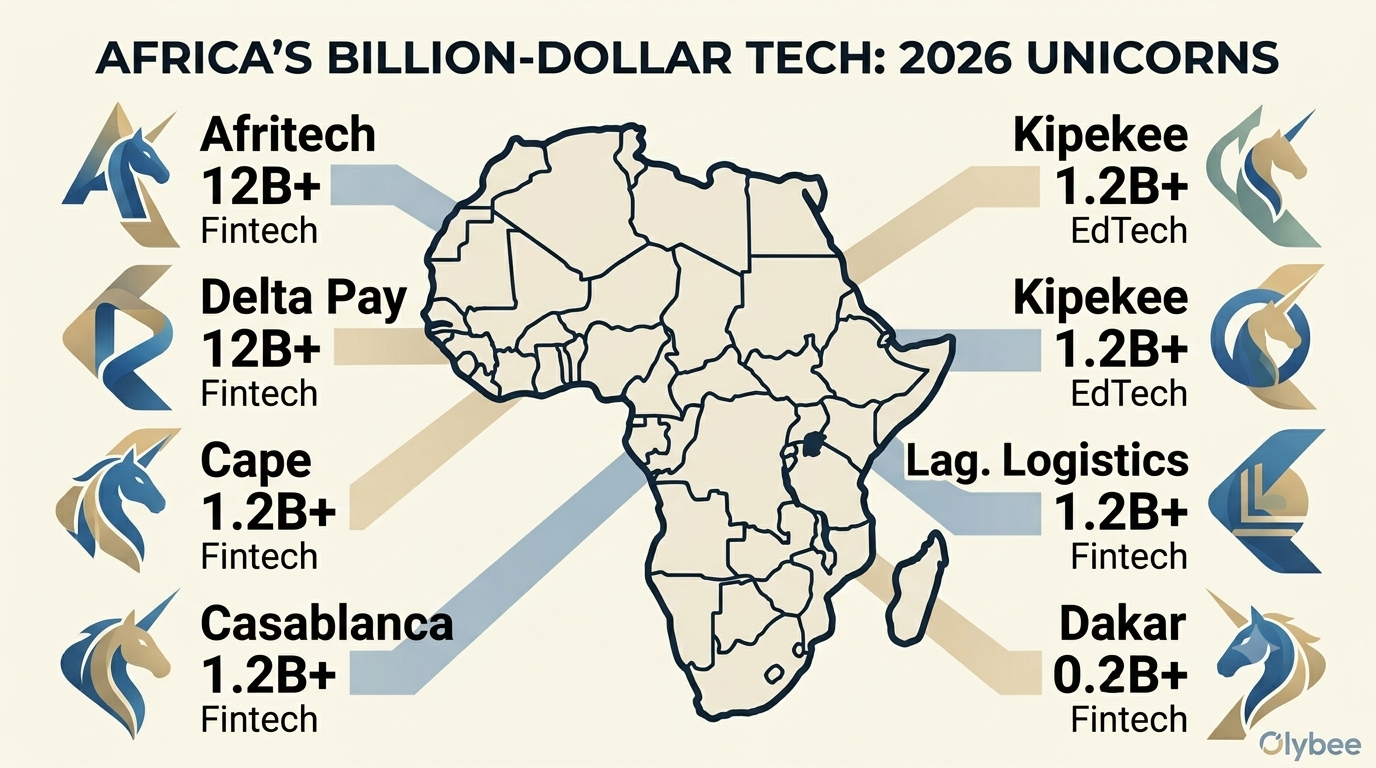

Africa’s unicorn companies in 2026 tell a powerful story about where the continent’s economic future is being built. Data compiled by Multiples.vc as of March 3, 2026 identifies 12 African tech companies currently valued at $1 billion or more – and the list reveals a striking pattern: fintech dominates, Nigeria leads in sheer numbers, and a handful of companies are redefining what it means to build at scale in an emerging market.
The Full List – Africa’s 12 Unicorns Ranked by Valuation
1. Naspers – $43.2B (South Africa, Public)
Naspers sits alone at the top by a massive margin. The South African media and investment conglomerate built its fortune through a prescient early stake in China’s Tencent, which remains the backbone of its enormous valuation. Naspers is a diversified global investment company that operates on a fundamentally different scale from typical venture-backed startups – making its inclusion on a unicorn list somewhat of a category unto itself. Still, it represents Africa’s single largest tech-adjacent market capitalisation.
2. Flutterwave – $5.2B (Nigeria, Private)
Nigeria’s crown jewel in payments infrastructure. Founded in 2018, Flutterwave provides payment solutions to individuals and businesses across Africa and facilitates transactions between them and international markets. Its $5.2B valuation makes it Africa’s most valuable privately held startup by a wide margin. Among true tech unicorns, Flutterwave leads the rankings and is reportedly preparing for an initial public offering – though the path to IPO will test whether its private valuation holds up to public market scrutiny.
3. OPay – $2.8B (Nigeria, Private)
Founded in 2018 and headquartered in Nigeria, OPay provides financial services to consumers and merchants across Africa and Asia, including payments, transfers, savings, loans, and point-of-sale services for agents. The company claims over 50 million users, 1 million merchants, and monthly transaction volumes surpassing $12 billion. SoftBank Vision Fund backed its $400M Series C, and OPay has since expanded aggressively beyond Nigeria into Egypt and Pakistan.
4. Wave – $1.7B (Senegal, Private)
Wave is the continent’s mobile money pioneer rooted in West Africa. It made history with a $200 million Series A – the largest Series A in African startup history – which gave it a $1.7 billion valuation. Operating primarily in Senegal and other Francophone African markets, Wave has taken aim at legacy operators by offering zero-fee money transfers, a bold proposition that has won it millions of loyal users.
5. Tyme Group – $1.5B (South Africa, Private)
Tyme is eyeing an IPO in New York by 2028, with plans for a secondary listing in South Africa. The digital banking group operates TymeBank in South Africa and GoTyme in the Philippines, with investors including Nubank – itself one of the world’s most valuable neobanks. Tyme’s hybrid model of digital apps combined with real-world touchpoints has been a key driver of its rise to unicorn status.
6. Andela – $1.5B (Nigeria, Private)
Originally a “hire, train, deploy” model for junior African developers, Andela has since morphed into a global marketplace matching experienced engineers in emerging markets with international companies. It remains one of Nigeria’s most globally recognised tech companies, connecting African tech talent directly with employers in the US, Europe, and beyond.
7. Fawry – $1.4B (Egypt, Public)
Egypt’s Fawry is one of only a few African tech unicorns that trades on a public stock exchange. The company operates a vast electronic payments and e-commerce services network used by millions of Egyptians to pay bills, settle fees, and conduct transactions through thousands of physical service points and digital channels across the country.
8. Datatec – $1.2B (South Africa, Public)
Datatec is a JSE-listed global IT solutions company headquartered in South Africa. Unlike the fintech-heavy rest of this list, Datatec operates across network infrastructure, systems integration, and managed services, with a presence in more than 50 countries. It trades at approximately 0.3 times revenue – a valuation multiple that highlights the stark gap between how public and private African tech companies are priced.
9. WeBuyCars – $1.1B (South Africa, Public)
South Africa’s leading used vehicle marketplace, WeBuyCars operates an asset-light model connecting buyers and sellers of second-hand cars at scale. The company went public and has continued growing its national footprint of buying hubs. WeBuyCars trades at just 0.7 times revenue, placing it firmly in the category of value-oriented public companies rather than high-multiple growth stories.
10. Interswitch – $1.0B (Nigeria, Private)
Interswitch is Africa’s oldest tech unicorn. In November 2019, Visa acquired a minority stake at a $1 billion valuation. The company holds a central role in Nigeria’s payment system, operating at a different scale and age than most firms on this list. Founded in 2002, Interswitch built the electronic payment switching infrastructure that underpins much of Nigeria’s financial system today – including the Verve card network.
11. MNT-Halan – $1.0B (Egypt, Private)
Egypt’s MNT-Halan became a unicorn in early 2023 after raising approximately $400 million in equity and securitised debt at a post-money valuation of roughly $1 billion. The company originally combined ride-hailing and logistics with micro-lending but has since focused on lending-led financial services, disbursing over $2 billion in loans to consumers and micro-entrepreneurs.
12. Moniepoint – $1.0B (Nigeria, Private)
The newest name on this list and arguably one of the most impressive growth stories. Moniepoint joined the unicorn club in October 2024, when it raised $110 million in a Series C from investors including Google’s Africa Investment Fund. At the time, Moniepoint processed over 1 billion transactions worth more than $22 billion monthly, with annualised revenue above $100 million and profitability. The company runs one of Nigeria’s largest agent-banking and POS networks and has operations in all of the country’s 774 local councils.
What the List Reveals About Africa’s Tech Economy
A few patterns stand out when you step back and look at the full picture.
Fintech completely dominates. Fintech is arguably the most successful category of African startups, accounting for eight out of nine of the companies valued at over $1 billion in the region. The sector’s concentration isn’t accidental – companies like Flutterwave, OPay, Interswitch, and Moniepoint share a defining characteristic: they sit at the financial core of everyday economic activity.
Nigeria and South Africa split the lion’s share. Nigeria claims five of the twelve spots — Flutterwave, OPay, Andela, Interswitch, and Moniepoint. South Africa accounts for four – Naspers, Tyme Group, Datatec, and WeBuyCars. Egypt contributes two in Fawry and MNT-Halan, while Senegal holds one with Wave.
Private versus public valuations tell different stories. The valuation metrics attached to private companies reveal a deeper tension. Flutterwave is valued at roughly 54.7 times its revenue. By contrast, publicly traded African firms operate at far lower multiples – Fawry at about 6.3 times, WeBuyCars at 0.7 times, and Datatec at approximately 0.3 times. This gap will face its biggest test as companies like Flutterwave and OPay move toward public listings.
Best Freelance Skills That Pay Well in 2026 →
Source: Multiples.vc, data as of March 3, 2026.








Leave a Reply
You must be logged in to post a comment.