



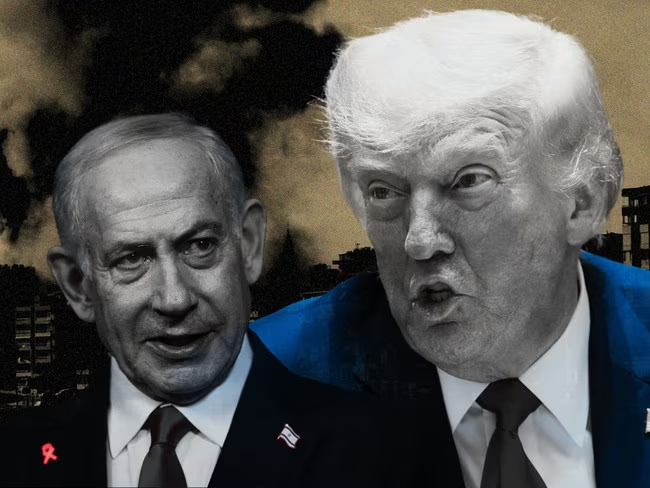

JERUSALEM / WASHINGTON It took less than 24 hours for a fragile Middle East ceasefire to unravel, and the damage it left behind to regional stability, to US-brokered peace talks, and to the relationship between Donald Trump and Benjamin Netanyahu may take far longer to repair.
Israel and Iran traded fire early Monday in their first attacks since the US struck a ceasefire two months ago, threatening to drag the Middle East back into a full-scale war. The war, launched by the US and Israel on February 28 with strikes on Iran, has shaken the global economy, driven energy prices up around the world and made many basics, including food, more expensive. Officials had been unable to turn the ceasefire, agreed April 8, into a deal to permanently end the conflict.
How It Unfolded
The sequence of events began on Sunday when Israel launched fresh strikes on Hezbollah strongholds in the Beirut area the first such attacks since the US announced a truce plan for Lebanon last week. Iran responded swiftly and with force.
Iran fired close to 30 ballistic missiles at Israel, according to the IDF, with Yemen’s Houthi rebels launching two more in the first such attacks since April. Israel responded with two waves of strikes on Iran, targeting aerial defense systems in the first wave and a petrochemical facility in the second. Iran then struck petrochemical infrastructure in Haifa, with footage showing missiles bearing a message in three languages: “You will regret this.”
The escalation drove oil prices up by nearly 5%, with benchmark Brent futures pushing back above $97 a barrel.
Iran’s central military command said in a statement it had “delivered a painful response” and that Israel “and its supporters must learn a lesson” from the strikes. Iran’s Foreign Ministry said the US “bears responsibility” for Israel’s actions as a party to the April ceasefire.
Trump Told Netanyahu to Stand Down Netanyahu Struck Anyway
The most consequential dimension of Monday’s crisis was not simply that the guns had started firing again it was who had been told to keep them quiet.
A senior US official told the Associated Press that Trump had called Netanyahu to urge him not to retaliate, and that he believed he had convinced Netanyahu to wait. That belief proved misplaced. Israel proceeded with its strikes anyway, making Netanyahu the second US president to be openly defied by an Israeli prime minister in this conflict.
Trump did not hide his frustration. He told the Financial Times: “It’s not going to have any impact on the deal. I call the shots. I call all the shots. He [Netanyahu] doesn’t call the shots.” He also told a Fox News reporter that Israel’s earlier strikes in Lebanon had not been coordinated with Washington, adding bluntly: “I’m not happy about it.”
The differences between the two leaders appear to be rooted in the domestic considerations of each. Netanyahu faces elections this fall and is under heavy public pressure to strike back against Iran.
“Immediately Stop Shooting”
On Monday, Trump took to Truth Social with a direct public demand. He told both Iran and Israel to “immediately stop” attacking each other, adding that he was optimistic both sides would back off, writing: “Both sides, Israel and Iran, are looking to do an immediate CEASEFIRE!”
Netanyahu subsequently said “the fire has been halted,” but warned that Israel would respond “with force” if Iran attacked again. By late Monday, a US official said an Israeli response to Tehran was not likely to be imminent, and Netanyahu was said to have agreed to delay further strikes after Trump urged restraint in a follow-up call.
The US State Department separately warned American citizens in Jordan to seek shelter as missiles transited the country’s airspace a sign of how rapidly the situation was spilling beyond its immediate geography.
A Deal on the Brink
The stakes for the wider diplomatic effort could not be higher. Trump had told the Financial Times just days earlier that negotiations for a permanent end to the Iran conflict were “very close” and predicted a deal would be announced this week. Monday’s exchanges, triggered in part by an Israeli strike on Hezbollah that Washington had explicitly asked Netanyahu to hold off on, have placed that timeline in serious jeopardy.
Iran’s Islamic Revolutionary Guard Corps warned that further attacks on non-military and energy targets would have consequences for the global economy. Pope Leo XIV, who happened to be addressing the Spanish parliament in Madrid on a peace-focused visit as the strikes unfolded, called war “a painful defeat of the capacity to negotiate.”
Whether Monday’s fragile pause holds or whether Netanyahu’s domestic political pressures once again override Washington’s diplomatic calendar is now the defining question hanging over the Middle East.




Leave a Reply
You must be logged in to post a comment.