
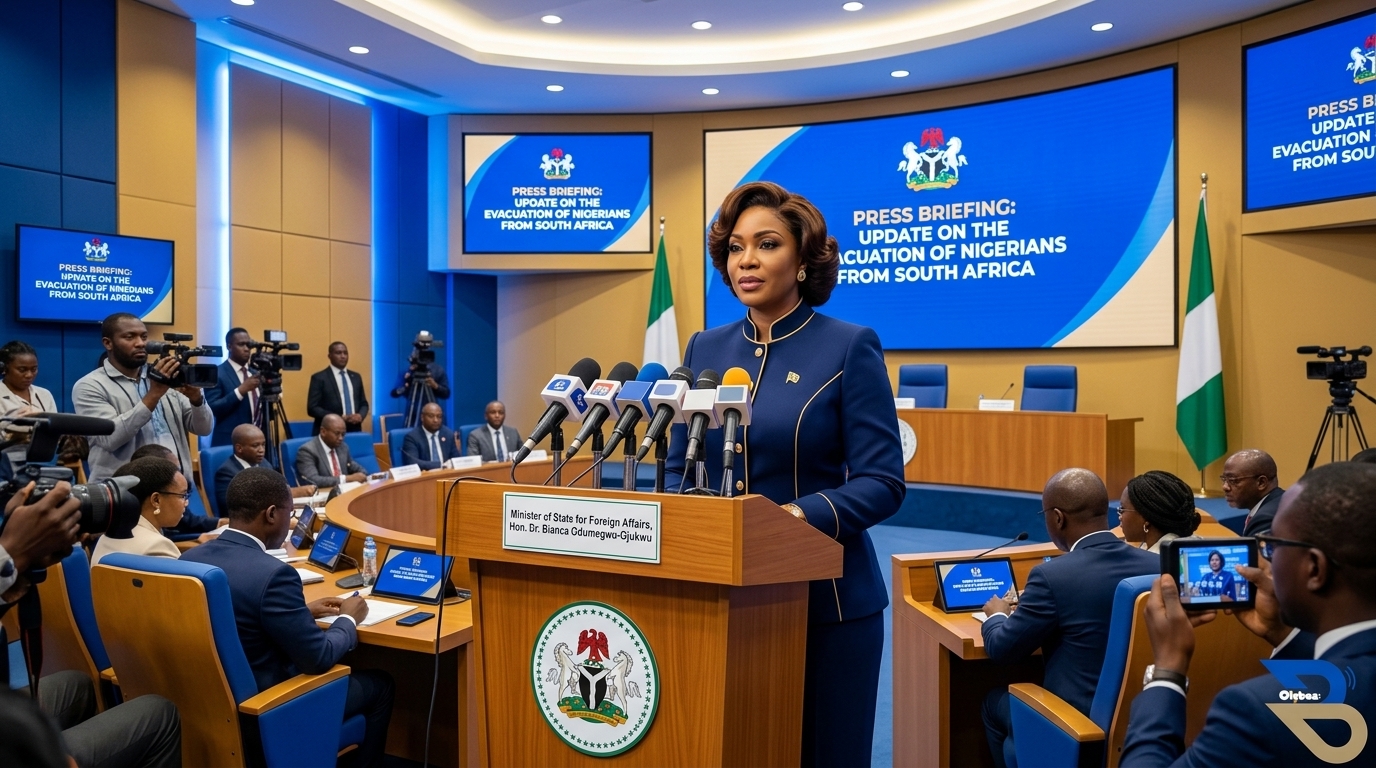



Nigeria’s evacuation of citizens from South Africa is now a race against the clock — and the Federal Government insists no one gets left behind. The Minister of Foreign Affairs, Ambassador Bianca Odumegwu-Ojukwu, announced on June 18 that every willing Nigerian currently caught in the wave of anti-migrant violence in South Africa will return home before June 30. The declaration signals one of the most urgent consular operations Nigeria has mounted in recent years.
The evacuation of Nigerians from South Africa follows a surge in xenophobic attacks targeting African migrants — including Nigerian nationals — across communities in South Africa. The violence has triggered a broad continental response, with several African countries now pulling their citizens out.
Nigeria’s Evacuation From South Africa: How the Operation Is Unfolding
The operation is already in motion. According to Odumegwu-Ojukwu’s statement, issued on Thursday and signed by her Special Assistant on Communication and New Media, Magnus Eze, the first batch of returnees touched down at Murtala Muhammed International Airport in Lagos on June 11. Altogether, 258 Nigerians arrived in that initial wave. The Minister of State for Foreign Affairs, Ambassador Sola Enikanolaiye, personally received them on arrival.
Beyond that first group, approximately 1,000 Nigerians had formally registered for evacuation as of the statement date. With 258 already airlifted, that leaves over 742 citizens still awaiting transportation. The Federal Government confirmed that arrangements to bring home the remaining registrants before the June 30 deadline were being finalised.

President Bola Tinubu specifically directed the Ministry of Foreign Affairs to prioritise and accelerate the process. Odumegwu-Ojukwu also made clear that no Nigerian who has voluntarily expressed a desire to return would be stranded or overlooked.
Furthermore, Nigeria is not alone in this response. Ghana, Malawi, Zimbabwe, and Mozambique have also begun evacuating their nationals from South Africa, reflecting the severity of the security situation on the ground for African migrants in the country.
The Human Reality Behind the Nigerian Evacuation From South Africa
Numbers and logistics only tell part of the story. Odumegwu-Ojukwu was candid about the complexity and human cost behind the crisis. She acknowledged that many affected Nigerians are not simply isolated workers or temporary migrants. Several have deep roots in South Africa — married to South African citizens, with children who were born and raised there. For these families, the decision to leave involves enormous personal sacrifice and uncertainty.
“When it comes to situations like this, of course, it is necessary to be temperate and exercise caution,” the minister said. “But when your citizens are being harassed… then it becomes a serious concern.”
She also raised a pointed observation about the uneven treatment of Nigerians relative to South African corporate interests operating inside Nigeria. Major South African brands — including MTN, MultiChoice, Stanbic, and Protea Hotels — run significant businesses across Nigeria. The minister signalled that this commercial relationship carries weight in the diplomatic conversation.
Additionally, Odumegwu-Ojukwu criticised the activities of anti-migrant vigilante groups in South Africa. Beyond the immediate physical danger they pose to migrants, she argued these groups inflict lasting reputational damage on South Africa itself — undermining the country’s carefully built image as a post-apartheid symbol of pan-African solidarity and unity.
Diplomatic Channels Open — But South Africa Sidesteps Early Warning Mechanism
Nigeria has engaged South African authorities through formal diplomatic channels. However, one particular point of friction emerged clearly. In October 2025, Nigeria and South Africa co-signed a Memorandum of Understanding establishing an early warning mechanism — specifically designed to protect citizens of both countries during periods of elevated tension. Critically, South African authorities have declined to activate this mechanism during the current crisis, citing procedural objections.
That refusal is a significant diplomatic sore point. Nigeria designed the MOU precisely for situations like this one. Its non-activation during an active crisis raises real questions about the commitment behind it. According to the South African Department of International Relations and Cooperation, South Africa maintains it welcomes African migrants who enter through legal channels — but the practical experience of thousands of Nigerian nationals on the ground tells a very different story.
The Federal Government, for its part, says it continues to explore all lawful diplomatic options to address the situation and protect Nigerian citizens who remain in South Africa.
Broader Context: Why Xenophobic Violence Keeps Erupting in South Africa
This latest episode is not South Africa’s first xenophobia crisis — and, without structural intervention, it likely will not be the last. South Africa has experienced recurring waves of anti-migrant violence since the late 2000s, driven by a volatile mix of unemployment, housing pressure, and political scapegoating of foreign nationals.
According to the United Nations High Commissioner for Refugees (UNHCR), South Africa hosts one of the largest urban refugee and asylum-seeker populations in the world. That reality, combined with South Africa’s own economic struggles, has repeatedly ignited tensions in communities where migrants and local residents compete for scarce resources and livelihoods.
The current wave appears particularly intense. The scale of the multinational evacuation response — Nigeria, Ghana, Malawi, Zimbabwe, and Mozambique all pulling citizens out simultaneously — underscores how serious conditions have become. Moreover, the involvement of organised anti-migrant vigilante groups adds a layer of coordinated hostility that distinguishes this episode from more spontaneous outbursts of the past.
What Happens Next for Returning Nigerians
As the June 30 deadline approaches, the Federal Government faces the operational challenge of ensuring all 742-plus remaining registrants successfully board flights home. Beyond the logistics, however, returning Nigerians will face their own set of challenges on arrival.
Many will return having lost businesses, properties, or savings built over years in South Africa. Some will arrive without a clear plan. The Federal Government’s broader support infrastructure for returnees — reintegration support, skills matching, and economic assistance — will therefore face real scrutiny in the weeks and months that follow the evacuation’s completion.
Odumegwu-Ojukwu’s statement focused primarily on the evacuation logistics and diplomatic framing. Details of post-arrival support programmes remain to be seen. What is clear, however, is that this crisis has pushed Nigeria-South Africa relations into genuinely tense territory — and the resolution of the xenophobic violence, not just the evacuation, will determine how quickly the two countries return to stable ground.
SEO METADATA
Focus Keyphrase:
SEO Title: | Olybee.com
Slug:
Meta Description: (155 characters)
Excerpt:
Tags:
Categories: News, Politics, Featured
Suggested Image Alt Text:
- “”
- “Nigerians evacuated from South Africa arriving at Lagos airport amid xenophobic attacks”






Leave a Reply
You must be logged in to post a comment.