



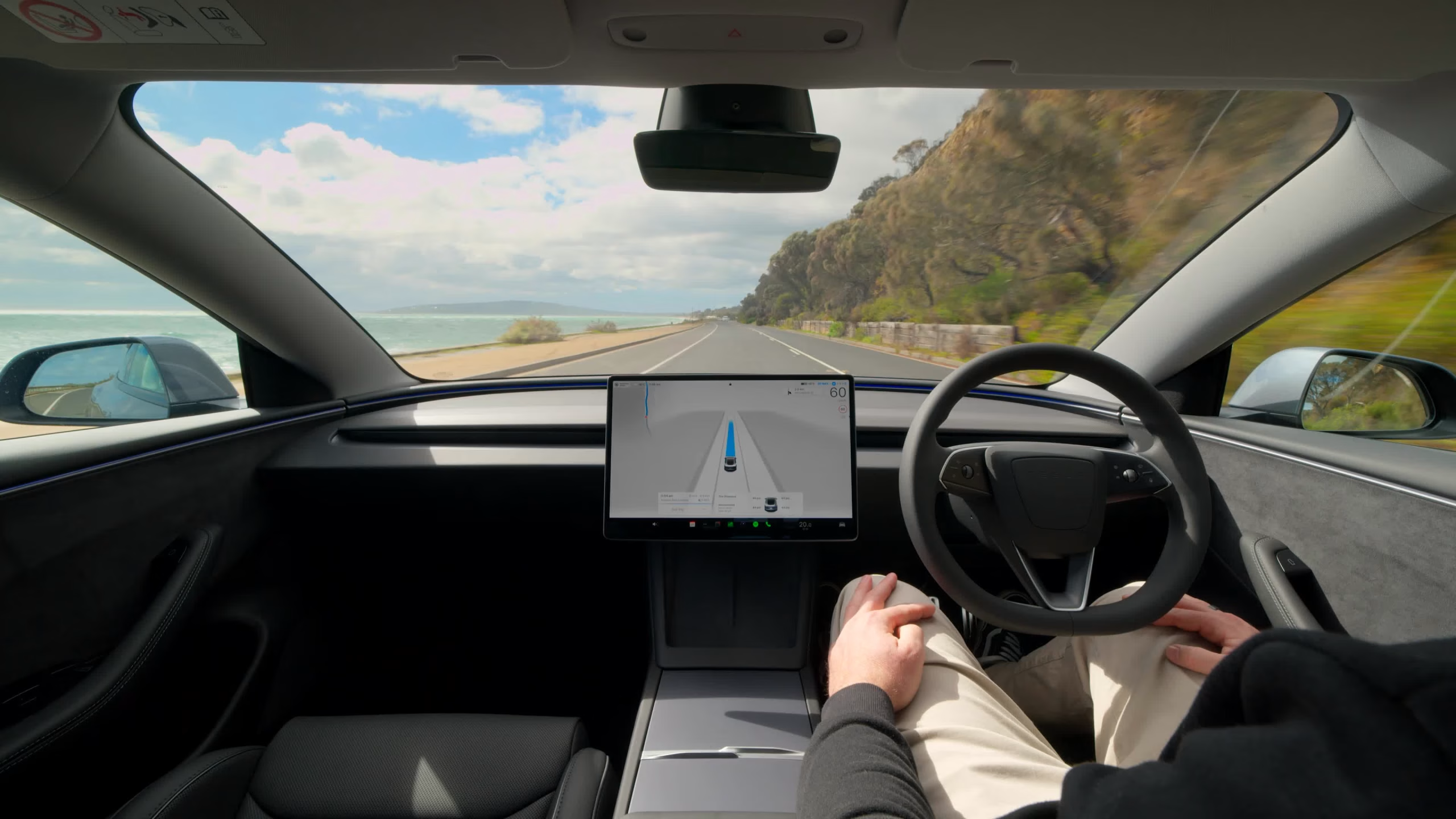
Tesla’s Full Self-Driving (Supervised) system has been approved in Denmark, making it the fourth European country to greenlight the advanced driver-assistance software in under two months, and prompting a direct confirmation from Elon Musk on X, where his post quickly racked up 18.5 million views. Tesla Europe confirmed the news on June 9, 2026, with a short statement: “FSD Supervised now approved in Denmark. Rollout will begin soon.”
The approval is particularly striking given that Denmark’s own regulators were previously among the voices raising safety concerns about the system at the EU level.
How Denmark Got to Yes
The Danish Road Traffic Authority, Færdselsstyrelsen, confirmed the decision on June 9 notably after Denmark had previously raised concerns about the technology at the EU level. The authority said it accepted the provisional type approval originally issued by the Dutch vehicle authority, RDW, on April 10, but stressed it had conducted its own independent review before signing off.
In a formal statement, Færdselsstyrelsen said it had undertaken a thorough review and assessment of the technical documentation before agreeing with RDW’s assessment that the system would contribute positively to road safety.
RDW spent 18 months testing the system and collected 1.6 million kilometres of European road data before certifying software version 2026.3.6 against more than 400 individual requirements. Under the EU framework, other member states can recognise that national approval without repeating the full testing process which is exactly what Denmark, Estonia, and Lithuania have done since the Netherlands opened the door in April.
Denmark’s approval means the software is now cleared for use across twelve global territories, covering the US, Canada, Mexico, Puerto Rico, China, Australia, New Zealand, South Korea, the Netherlands, Lithuania, Estonia, and now Denmark.
The Regulatory Split Running Through Europe
Denmark’s approval lands at a complicated moment for Tesla’s broader European ambitions. The gap between EU-level skepticism and national-level approval highlights a two-track regulatory process now playing out across Europe, the national-recognition route keeps moving, but the EU-wide process remains stalled.
Regulators in Sweden, Finland, Denmark, and Norway had all raised substantive safety objections to FSD following the Dutch approval, questioning the system’s handling of speed limits, its performance on icy road conditions, and whether the “Full Self-Driving” branding genuinely represents the technology’s capabilities.
A Swedish Transport Agency investigator wrote in April that he was “quite surprised” to learn Tesla allowed FSD to exceed posted speed limits, and said that should not be permitted. Finnish officials questioned whether Tesla was really introducing a system that allows hands-free driving on icy 80 km/h roads. Nordic regulators also raised the specific question of how the system would handle moose on the roads.
Denmark’s change of position is therefore significant when a country that raised concerns about speeding and icy-road performance turns around and approves the system two months later, it suggests the technical documentation was more convincing than the initial political objections implied.
At the EU-wide level, Tesla had originally targeted bloc-wide availability by summer 2026, but the June 30 committee agenda allocates time only for further discussion not a vote. That pushes a bloc-wide decision toward autumn at the earliest, with some industry trackers now projecting full EU recognition slipping into early 2027.
For full EU recognition, Tesla needs at least 15 of the 27 member states representing 65% of the EU population to vote in favour. Belgium and Greece are reportedly moving quickly toward their own national approvals, while Ireland, Germany, France, Italy, and Spain are still reviewing or testing.
What FSD Supervised Actually Does – and What It Doesn’t
Despite the name, this is not a self-driving car. FSD (Supervised) can drive the vehicle almost anywhere under driver supervision starting from a parked position, making lane changes, selecting forks to follow a navigation route, navigating around other vehicles and objects, making turns, and stopping at a destination. But the driver must remain attentive and in control at all times. The system does not make the vehicle autonomous.
Tesla’s approach differs from rivals’ systems in its reliance on a vision-only, end-to-end neural network rather than detailed maps and lidar sensors. Safety groups including the European Transport Safety Council have separately questioned how reliably driver-monitoring systems keep attention on the road, and how the technology performs at night and in winter conditions. African BusinessData Explained
New European users must complete a mandatory tutorial and quiz before first use. The subscription is priced at €99 per month, with a discounted €49 per month rate available to owners who previously purchased Enhanced Autopilot.
According to Tesla, FSD Supervised is 3.4x safer on highway roads and 1.6x safer on non-highway roads compared to human drivers. Those figures come from Tesla’s own data and have not been independently verified by European regulators.
For the latest country-by-country regulatory status, fsdtracker.eu maintains a live map of approvals across Europe.
Top Property Investment Trends in Denmark Right Now →
“Africa’s Unicorn Companies 2026 →
The pace of approvals across Europe tells a clear story: Tesla’s country-by-country strategy is working faster than Brussels can deliberate. Whether the EU ultimately rubber-stamps the system for all 27 member states or leaves a patchwork of national decisions in place is the question that will define FSD’s European future.




Leave a Reply
You must be logged in to post a comment.