



A Covenant University graduate experience has gone viral on LinkedIn — and it is sparking serious conversations about one of Nigeria’s most talked-about private universities. Timothy Adewole, an engineering alumnus of the Ota-based institution popularly called the “Purple City,” took to the professional networking platform to push back firmly against the steady stream of criticism and rumours surrounding his alma mater. His post, detailed and deeply personal, quickly drew a wave of reactions from fellow graduates and curious onlookers alike.
So what exactly did he say? Quite a lot — and quite powerfully.
What the Covenant University Graduate Experience Actually Looked Like
Adewole did not mince words when acknowledging the noise surrounding Covenant University. He openly admitted that he had heard all the familiar criticisms before stepping foot on campus — overpriced, poorly administered, full of superficiality. However, after five years inside what he affectionately calls “Canaanland,” his verdict lands on the other side of the debate entirely.
“I’m glad I was there,” he wrote. “For 5 years. I was made there. I was built within the four walls of the Purple City.”
He described a transformation that went well beyond academics. In his telling, Covenant University converted him from a boy into a man. It handed him a vision for his future. Moreover, it surrounded him with people and systems that fanned what he called “a burning passion for global relevance.” Crucially, he acknowledged that the institution is not perfect — but then argued that no system ever is.
“While others took offense, I chose to see beyond the inadequacies,” he said. “Early enough, I understood that no system is perfect. So why crucify a system for its weak spots in a way that almost erases the impact it has made?”
That framing — choosing perspective over complaint — runs through every paragraph of his post. It is, in many ways, the heart of his message.
Covenant University’s Unique Programs That Shaped Him
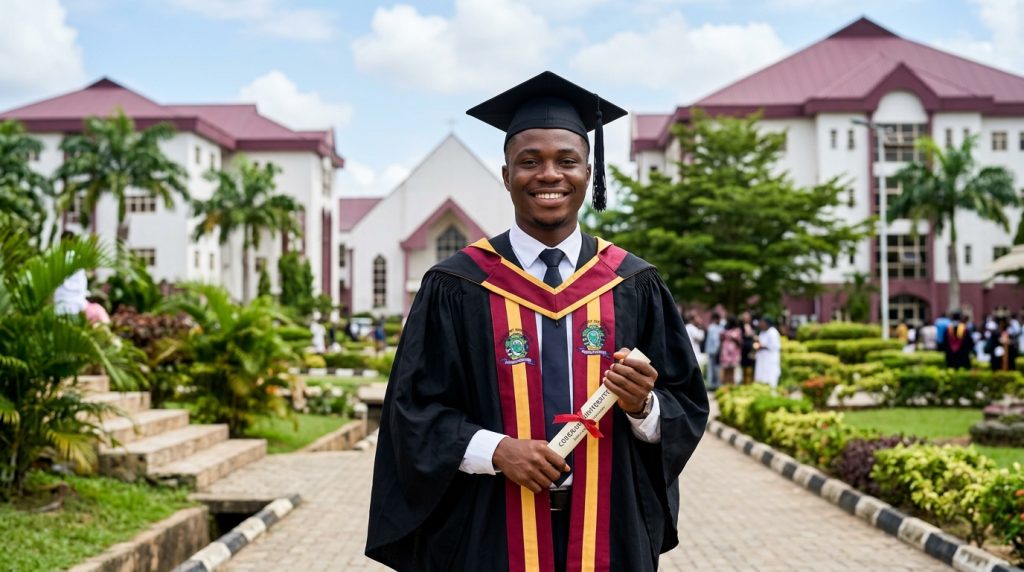
Beyond the emotional journey, Adewole got specific. He listed several unique aspects of the Covenant University experience that he credits for shaping his character, career outlook, and leadership capacity. Notably, these are not standard academic offerings — they reflect the institution’s distinctive faith-based and holistic development philosophy.
He pointed first to the university’s chaplaincy, which he described as the fuel behind his spiritual growth and leadership confidence. Then came the relationships — friendships and professional connections built on campus that he says continue to drive him forward today. He also highlighted the physical environment itself. Adewole called it a genuinely safe space for learning — free from the culture of criminality that plagues some other campuses.
Additionally, he singled out several specific programmes. TMC classes, he said, “brainwashed” him into greatness — a deliberately provocative choice of words, given that critics often use similar language to attack the university’s culture. DLD classes, he added, sharpened his leadership instincts. EDS classes unlocked his creative thinking. And TTG expanded his worldview in ways he says he still draws on today.
He also credited the faculty — professors and lecturers who, in his experience, became genuine mentors rather than distant academic figures. Furthermore, he noted something intangible but powerful: a spiritual covering he did not fully appreciate until after graduation.
Finally, he cited the Covenant University name itself — what he calls the “EAGLE” identity — as something that continues to open professional doors for him long after leaving campus.
His Parents’ Hope — And Whether It Was Fulfilled
One of the most moving parts of Adewole’s post shifts the perspective from student to parent. He described what Covenant University meant not just to him personally, but to his mother and father who invested in sending him there.
“Covenant University was not just a school for my parents,” he wrote. “It was their hope — their desperate hope — that their son would become something meaningful they could be proud of.”
He then asked himself directly whether that hope was realised. His answer? “A thousand times, yes.”
That line, simple as it is, resonated strongly with many readers on LinkedIn. For thousands of Nigerian families, sending a child to Covenant University involves real financial sacrifice. The school’s fees rank among the highest for private universities in the country, according to a review of Nigerian university tuition data. Critics who label it overpriced often focus exclusively on that cost. Adewole’s framing inverts the calculation — asking not what was spent, but what was returned.
LinkedIn Reacts: Thousands of CU Alumni Answer the Call
At the close of his post, Adewole turned the conversation outward. He addressed fellow Covenant University alumni directly, asking a simple but powerful question: “What did Covenant University give you?”
The response was immediate and substantial. Fellow graduates flooded the comments section with their own stories, expressions of gratitude, and warm congratulations. Many echoed his core sentiment — that despite the institution’s strict rules, high fees, and the occasional controversy, the CU experience shaped them in ways other environments simply could not have.
The reaction also drew commentary from people who never attended the university. Some expressed genuine curiosity. Others remained sceptical but acknowledged the sincerity and specificity of Adewole’s account. A few critics held firm — but even within the pushback, the conversation shifted in tone from dismissal to genuine debate.
This kind of alumni-driven narrative matters more than it might initially seem. Research on university reputation management consistently shows that authentic graduate testimony carries more credibility with prospective students than any formal marketing campaign. When thousands of scattered alumni speak in a unified voice, they become the institution’s most powerful advertisement — and its most credible defenders.
The Broader Debate About Private University Education in Nigeria
Adewole’s post lands at a moment when conversations about private university education in Nigeria are particularly lively. With public universities repeatedly disrupted by strikes, funding shortfalls, and infrastructure challenges, private institutions like Covenant University have steadily grown their appeal — despite the cost barrier.
Covenant University, founded in 2002 by Living Faith Church Worldwide under Bishop David Oyedepo, has consistently ranked as one of Nigeria’s top universities in global rankings. It has also attracted controversy over its strict campus policies — including rules on dress code, relationships, and religious participation — which critics argue border on excessive control.
However, Adewole’s story puts a human face on what that structure can produce. He does not claim the system is without flaws. Instead, he makes a different argument entirely: that the outcomes — for him, and for thousands of others like him — justify the investment and validate the experience.
Whether that argument convinces critics is another matter. But it is hard to read his post and dismiss it as the words of someone who was simply too immersed to see clearly. He acknowledges the criticisms. He chooses gratitude anyway. And he invites every fellow alumnus to do the same.






Leave a Reply
You must be logged in to post a comment.